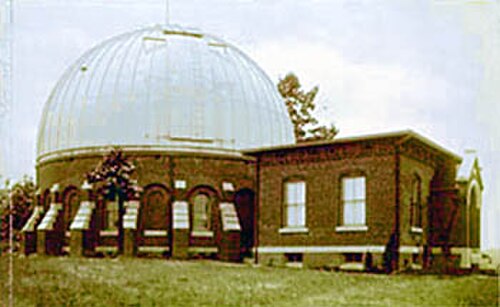
Size mattered in 1885. When the University of Virginia dedicated the Leander McCormick Observatory on a ridge just outside Charlottesville, its 26-inch refracting telescope reigned as the largest in the United States. The glass blank itself, ground by the legendary Alvan Clark and Sons, had actually sat in a Boston workshop for years because the donor, Chicago industrialist Leander McCormick, struggled to find a southern institution that could afford to house it. UVA eventually stepped up. They secured a dome designed by Warner and Swasey, which featured a three-ton shutter that a single assistant could hand-crank. A mechanical marvel.
Actually, the observatory quickly turned into an absolute workhorse for stellar cartography. Under the leadership of astronomer Samuel Alfred Mitchell, who took the reins in 1913, the facility launched a massive effort to calculate the distances to nearby stars. They used stellar parallax. This technique required taking photos of the same star six months apart to see how much it appeared to shift against the background of deeper space. By the time Mitchell retired, his team had captured over 80,000 photographic plates. That was more parallax determinations than any other observatory on earth at the time. An incredible feat of patience.
Light pollution eventually choked out the deep-space views, forcing modern research to move elsewhere. Still, the building survived. Instead of rotting into a historical footnote, the facility became a teaching tool. UVA students still climb the wooden steps today to peer through the same glass that McCormick bought back in the Reconstruction era. It still works perfectly, too. A century of starlight captured through a single lens.
- T Walker
What Makes McCormick, Leander, Observatory Special: